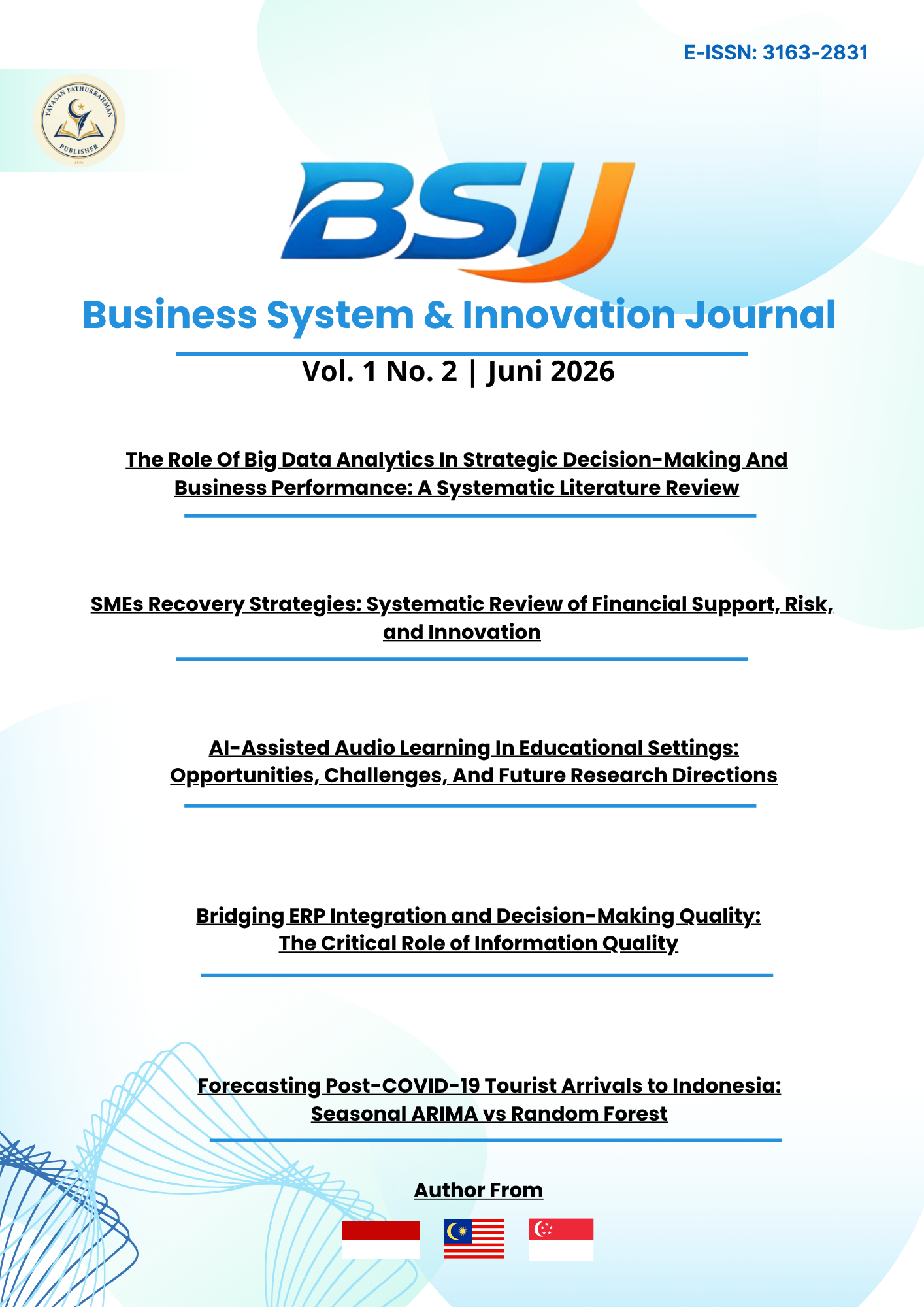
AI-Assisted Audio Learning In Educational Settings: Opportunities, Challenges, And Future Research Directions
DOI:
https://doi.org/10.67955/bsij.v1i2.19Keywords:
artificial intelligence, learning media, technology acceptance model, perceived trust, high school students, behavioral intentionAbstract
This systematic literature review examines how audio-based artificial intelligence (AI) tools are being used to support learning across educational contexts and what challenges and opportunities arise from their implementation. Using a structured search across major e-scientific databases, this study identified and analysed empirical and conceptual works on AI assisted audio learning, including audio feedback, voice tutors/assistants, adaptive audio modules, and AI generated podcasts. VOSviewer was employed to map keyword co-occurrences and thematic clusters, while a large language model (LLM)-based notebook was used to assist in summarising abstracts, methods, and key findings, and to group studies by educational level and AI technology type. The findings indicate that audio-based AI interventions generally contribute positively to cognitive outcomes, motivation, and engagement, particularly by enabling frequent, personalised feedback and flexible, on-the-go learning opportunities. At the same time, the review reveals several challenges related to instructional design, teacher orchestration, data privacy, and the risk of learner overreliance on AI feedback. The existing evidence is heavily concentrated in language learning and a few specialised domains, with a predominance of short-term studies and self-report measures, limiting the generalisability of current conclusions. This review contributes by offering an updated mapping of AI-assisted audio learning research, highlighting underexplored contexts and design configurations, and outlining clear directions for future studies, including longitudinal designs, comparative trials of audio versus text-based feedback, and investigations into how teachers and students negotiate the role of AI in classroom practice.
References
Ariya, P, S Khanchai, K Intawong, and K Puritat. 2025. “Enhancing Textile Heritage Engagement through Generative AI-Based Virtual Assistants in Virtual Reality Museums.” Computers and Education: X Reality 7. https://doi.org/10.1016/j.cexr.2025.100112.
Baldrich, Kevin, Carmen Pérez-García, and María Santamarina-Sancho. 2025. “Artificial Intelligence in Academic Literacy: Empirical Evidence on Reading and Writing Practices in Higher Education.” Frontiers in Education 10 (November): 1–10. https://doi.org/10.3389/feduc.2025.1701238.
Bland, T. 2025. “Enhancing Medical Student Engagement Through Cinematic Clinical Narratives: Multimodal Generative AI–Based Mixed Methods Study.” JMIR Medical Education 11. https://doi.org/10.2196/63865.
Cooper, G, K Ilich, and K Sturrock. 2026. “Using Generative Artificial Intelligence to Reimagine Feedback in Higher Education: A Collaborative Autoethnography.” Assessment and Evaluation in Higher Education. https://doi.org/10.1080/02602938.2026.2653889.
Crompton, H, A Edmett, N Ichaporia, and D Burke. 2024. “AI and English Language Teaching: Affordances and Challenges.” BRITISH JOURNAL OF EDUCATIONAL TECHNOLOGY 55 (6): 2503–29. https://doi.org/10.1111/bjet.13460.
Darmawansah, D, G J Hwang, C J Lin, and F Febiyani. 2025. “An Artificial Intelligence-Supported GFCA Learning Model to Enhance L2 Students’ Role-Play Performance, English Speaking and Interaction Mindset.” ETR&D-EDUCATIONAL TECHNOLOGY RESEARCH AND DEVELOPMENT 73 (3): 1451–79. https://doi.org/10.1007/s11423-025-10453-6.
Fuchs, S, A Werth, C Méndez, and J Butcher. 2025. “Leveraging AI-Generated Synthetic Data to Train Natural Language Processing Models for Qualitative Feedback Analysis.” Journal of Engineering Education 114 (4). https://doi.org/10.1002/jee.70033.
Giannakos, M, R Azevedo, P Brusilovsky, M Cukurova, Y Dimitriadis, D Hernandez-Leo, S Jaervelae, M Mavrikis, and B Rienties. 2025. “The Promise and Challenges of Generative AI in Education.” BEHAVIOUR & INFORMATION TECHNOLOGY 44 (11): 2518–44. https://doi.org/10.1080/0144929X.2024.2394886.
Grützmacher, L, B Herbert, D Holzberger, A Naumann, M Steffensky, and S Vieluf. 2025. “Critical Examination of the Measurement Quality of Student Outcomes: A Systematic Review.” SCHOOL EFFECTIVENESS AND SCHOOL IMPROVEMENT 36 (2): 211–41. https://doi.org/10.1080/09243453.2025.2482579.
Hamman-Ortiz, L, C Doughtery, Z F Tian, D Palmer, and L Poza. 2025. “Translanguaging at School: A Systematic Review of US PK-12 Translanguaging Research.” SYSTEM 129. https://doi.org/10.1016/j.system.2025.103594.
Higgins, J, and S Green, eds. 2008. “Cochrane Handbook for Systematic Reviews of Interventions.” West Sussex: John Wiley & Sons.
Hong, Jon-Chao, and Tzu-Yu Tai. 2025. “Exploring the Role of Internet Self-Efficacy, Perceived Enjoyment, and Anxiety on Learning Outcome in Intelligent Personal Assistant-Based EFL Learning.” Innovation in Language Learning and Teaching 19 (2): 136–54. https://doi.org/10.1080/17501229.2024.2347884.
Huang, J. 2024. “Enhancing EFL Speaking Feedback with ChatGPT’s Voice Prompts.” International Journal of TESOL Studies 6 (3): 4–13. https://doi.org/10.58304/ijts.20240302.
Kasneci, Enkelejda, Kathrin Sessler, Stefan Küchemann, Maria Bannert, Daryna Dementieva, Frank Fischer, Urs Gasser, et al. 2023. “ChatGPT for Good? On Opportunities and Challenges of Large Language Models for Education.” Learning and Individual Differences 103:102274. https://doi.org/https://doi.org/10.1016/j.lindif.2023.102274.
Kerr, Sharon. 2017. “Exploring the Impact of Artificial Intelligence on Teaching and Learning in Higher Education.” https://doi.org/10.1186/s41039-017-0062-8.
Kitchenham, Barbara, Rialette Pretorius, David Budgen, O Pearl Brereton, Mark Turner, Mahmood Niazi, and Stephen Linkman. 2010. “Systematic Literature Reviews in Software Engineering – A Tertiary Study.” Information and Software Technology 52 (8): 792–805. https://doi.org/https://doi.org/10.1016/j.infsof.2010.03.006.
Koolivand, H, M M Shooreshi, R Safari-Faramani, M Borji, M S Mansoory, H Moradpoor, M Bahrami, and S M Azizi. 2024. “Comparison of the Effectiveness of Virtual Reality-Based Education and Conventional Teaching Methods in Dental Education: A Systematic Review.” BMC MEDICAL EDUCATION 24 (1). https://doi.org/10.1186/s12909-023-04954-2.
Krsti, Lazar, Veljko Aleksi, Marija Krsti, Vocational Studies, Southern Serbia, and Technical Sciences. 2022. “Artificial Intelligence in Education : A Review,” no. September. https://doi.org/10.46793/TIE22.223K.
Li, W, X Cui, P Manoharan, L Dai, K Liu, and L Huang. 2025. “AI-Assisted Feedback and Reflection in Vocal Music Training: Effects on Metacognition and Singing Performance.” Frontiers in Psychology 16. https://doi.org/10.3389/fpsyg.2025.1598867.
Lin, Haozhuo, and Qiu Chen. 2024. “Artificial Intelligence (AI) -Integrated Educational Applications and College Students’ Creativity and Academic Emotions.” https://doi.org/10.1186/s40359-024-01979-0.
Lin, Y, X Wang, H Ma, L Wang, F Hao, and Z Cai. 2023. “An Efficient Approach to Sharing Edge Knowledge in 5G-Enabled Industrial Internet of Things.” IEEE Transactions on Industrial Informatics 19 (1): 930–39. https://doi.org/10.1109/TII.2022.3170470.
Liu, Y, S Ma, and Y Chen. 2024. “The Impacts of Learning Motivation, Emotional Engagement and Psychological Capital on Academic Performance in a Blended Learning University Course.” FRONTIERS IN PSYCHOLOGY 15. https://doi.org/10.3389/fpsyg.2024.1357936.
Michou, I, A Fouras, D Chrysanthakopoulou, M Theodoritsi, S Mariettou, S Stellatou, and C Koutsojannis. 2026. “AI-Powered Physiotherapy: Evaluating LLMs Against Students in Clinical Rehabilitation Scenarios.” Applied Sciences (Switzerland) 16 (3). https://doi.org/10.3390/app16031165.
Paradis, J. 2023. “Sources of Individual Differences in the Dual Language Development of Heritage Bilinguals.” JOURNAL OF CHILD LANGUAGE 50 (4): 793–817. https://doi.org/10.1017/S0305000922000708.
Praetorius, A K, A Jentsch, J Luoto, S D Keller, and B Fauth. 2025. “Context in Research on Teaching Quality: Bringing a Complex Idea into the Spotlight.” SCHOOL EFFECTIVENESS AND SCHOOL IMPROVEMENT 36 (2): 263–96. https://doi.org/10.1080/09243453.2025.2482577.
Ratten, V. 2023. “The Post COVID-19 Pandemic Era: Changes in Teaching and Learning Methods for Management Educators.” INTERNATIONAL JOURNAL OF MANAGEMENT EDUCATION 21 (2). https://doi.org/10.1016/j.ijme.2023.100777.
Rienties, B, J Domingue, S Duttaroy, C Herodotou, F Tessarolo, and D Whitelock. 2025. “What Distance Learning Students Want from an AI Digital Assistant.” Distance Education 46 (2): 173–89. https://doi.org/10.1080/01587919.2024.2338717.
Shi, H W, and V Aryadoust. 2024. “A Systematic Review of AI-Based Automated Written Feedback Research.” RECALL 36 (2): 187–209. https://doi.org/10.1017/S0958344023000265.
Strielkowski, Wadim, Veronika Grebennikova, Alexander Lisovskiy, Guzalbegim Rakhimova, and Tatiana Vasileva. 2025. “AI-Driven Adaptive Learning for Sustainable Educational Transformation.” Sustainable Development 33 (2): 1921–47. https://doi.org/10.1002/sd.3221.
Sungkur, R K, and N Shibdeen. 2025. “Pronunciation Trainer for Second Language Learning Using Generative AI.” International Journal of Educational Technology in Higher Education 22 (1). https://doi.org/10.1186/s41239-025-00561-x.
Tomchakovskyi, O, Y Tomchakovska, L Strochenko, L Shvelidze, and S Yeryomenko. 2026. “Multimodal AI Tools as Mediators of Linguistic Development in EFL Academic Writing.” Arab World English Journal 2026-January (Special Issue 3): 390–403. https://doi.org/10.24093/awej/A3.25.
Uppalapati, P J, M Dabbiru, and V R Kasukurthi. 2025. “AI-Driven Mock Interview Assessment: Leveraging Generative Language Models for Automated Evaluation.” International Journal of Machine Learning and Cybernetics 16 (12): 10057–79. https://doi.org/10.1007/s13042-025-02529-9.
Wang, Shan, Fang Wang, Zhen Zhu, Jingxuan Wang, Tam Tran, and Zhao Du. 2024. “Artificial Intelligence in Education : A Systematic Literature Review.” Expert Systems With Applications 252 (PA): 124167. https://doi.org/10.1016/j.eswa.2024.124167.
Yang, F F, L F Ren, and C Gu. 2022. “A Study of College Students’ Intention to Use Metaverse Technology for Basketball Learning Based on UTAUT2.” HELIYON 8 (9). https://doi.org/10.1016/j.heliyon.2022.e10562.
Yang, T C, Y C Hsu, and J Y Wu. 2025. “The Effectiveness of ChatGPT in Assisting High School Students in Programming Learning: Evidence from a Quasi-Experimental Research.” INTERACTIVE LEARNING ENVIRONMENTS 33 (6): 3726–43. https://doi.org/10.1080/10494820.2025.2450659.
Zerkouk, Meriem, Miloud Mihoubi, and Belkacem Chikhaoui. 2025. “A Comprehensive Review of AI-Based Intelligent Tutoring Systems: Applications and Challenges.” http://arxiv.org/abs/2507.18882.
Zhang, W, W Zhang, T Daım, and H Yalcin. 2025. “AI Challenges Conventional Knowledge Management: Light the Way for Reframing SECI Model and Ba Theory.” Journal of Knowledge Management 29 (5): 1618–54. https://doi.org/10.1108/JKM-02-2024-0203.
Downloads
Published
Issue
Section
License
Copyright (c) 2026 Muhammd Fauzan Hawari, Afifah Mesha Putri, Akmal Andri Yantama, Siti Syahsudarmi (Author)

This work is licensed under a Creative Commons Attribution 4.0 International License.